

June 2026
Valves, Pumps, Turbomachinery and Compression
Innovations in liquid ammonia pumping technologies and applications
The global push for decarbonization and mandates to reduce carbon emissions from energy sectors have positioned hydrogen (H2) as a leading clean energy resource of the future. However, the challenges associated with the storage and transport of H2, namely its small molecular size and the requirement for extremely low cryogenic pumping temperatures, have prompted the exploration of alternative energy carriers. In this context, ammonia (NH₃) has emerged as a compelling and more practical medium for storing and transporting H2. Moreover, NH₃ is increasingly being adopted directly in power generation and industrial applications as a carbon-free fuel.
While NH₃ pumping technologies have been in use for some time, primarily in fertilizer plants for transportation and storage, the size and capacity of existing applications are relatively limited. The growing global supply chain demand for carbon-free energy necessitates a significant scaleup of current NH₃ pumping technologies to handle much higher capacities and pressures. This detailed review focuses on the current state and technical challenges of liquid NH₃ pumping, with a particular emphasis on sealless centrifugal pumps (canned motor pumps and magnetically coupled pumps), which are favored for their safety, compactness, reliability and environmental friendliness compared to pumps utilizing mechanical seals.
NH₃’s role as a H2 carrier and fuel. The practical appeal of NH₃ as a H2 carrier lies in its less demanding storage and transportation conditions. Unlike H2, which requires cooling to a cryogenic temperature of –253°C (–423°F), liquid NH₃ can be stored at –33°C (–27.4°F) under atmospheric pressure. This temperature difference significantly simplifies logistical challenges. Furthermore, using NH₃ minimizes the boil-off gas losses during transportation and storage. Although both are classified as hazardous fluids, the flammability of H2 is considerably greater than that of NH₃. NH₃ benefits from an established supply chain and infrastructure, largely due to its extensive use in fertilizer production, which further enhances its feasibility as a transport medium for H2. The process involves dissociating the NH₃ back into H2 and nitrogen (N2) via an NH₃ cracking process at the point of use.
Beyond its role as a carrier, NH₃ is rapidly gaining traction as a direct carbon-free fuel. Japan, for instance, has been actively exploring NH₃ as an alternative to fossil fuels in power plants due to its heavy reliance on the latter.1 NH₃ is a high-energy-density fuel, and crucially, since it contains no carbon molecules, its combustion releases no carbon dioxide. New technological advancements in NH₃ power plants are capable of reducing harmful byproducts such as nitrogen oxides (NOx), thereby minimizing their atmospheric release.2 In Asia, there is an ongoing movement to upgrade coal plants to utilize NH₃, often through coal co-firing applications, where NH₃ is blended with coal to achieve a reduced pollution option (FIG. 1).
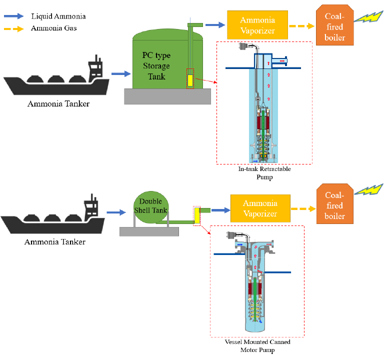
FIG. 1. Supply flow of NH3 for a coal power plant. Photo courtesy of SIP.
Essentials for liquid-phase pumping. Pumps are engineered to raise the pressure of a process fluid while it remains in its liquid phase, resulting in negligible compression and minimal change in fluid density. In the case of liquid NH3, the fluid can be assumed incompressible, as its density variation with pressure change is < 1%. The fundamental advantage of handling NH3 in its liquid phase stems from its density: liquid NH3 is significantly denser than NH3 gas. Under standard atmospheric pressure, saturated liquid NH3 is approximately 950 times denser than ambient-temperature NH3 gas, a considerable advantage for transportation and storage efficiency.
To maintain this liquid state at atmospheric pressure, NH3 must be refrigerated and liquefied at a temperature of approximately –33°C (–27.4°F). This liquefaction process, which involves cyclic compression and cooling, adds to the capital cost; however, storing and transporting NH3 in the liquid phase remains the most practical and feasible approach.
NH3 storage in fertilizer plants, the long-standing primary application, typically involves large, prestressed concrete tanks. These tanks can reach heights of 130 ft. (40 m) and store up to 55,115 tons (50,000 metric tons). Due to their construction and size, these tanks cannot be pressurized and are designed for a low internal pressure of 2.18 psig (150 millibar). They rely on thermal insulation to maintain the liquid temperature at approximately –33°C (–27.4°F). Given that process piping is absent from the side and bottom sections of these prestressed concrete tanks, pumps must be installed at the bottom of the tank inside a pump column via a specialized retraction system, classifying them as in-tank retractable pumps, as shown in FIG. 2.
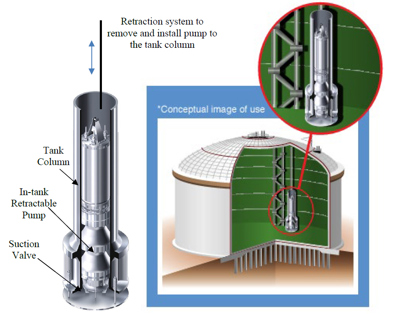
FIG. 2. Retractable NH3 pump installed in a prestressed concrete storage tank.3
Challenges of handling liquid NH3. The properties of liquid NH3 present distinct engineering challenges that influence pump design and selection. In terms of toxicity and flammability, NH3 is toxic to human tissues and corrosive to copper and galvanized surfaces. It is classified as a gas at standard temperatures and pressures and is flammable under certain environmental conditions. The U.S. Occupational Safety and Health Administration (OSHA) sets the permissible exposure limit at 50 parts per million (ppm) averaged over an 8-hr workday,4 as even fairly low airborne concentrations can cause rapid onset of eye, nose and throat irritation.5 Furthermore, NH3 is classified as a Class 2, Division 2 flammable gas, with a flammability range of 13% by volume (lower limit 15%, upper limit 28%). Due to this toxicity and flammability, sealless pumps are overwhelmingly preferred for their superior reliability and safety.
NH3's corrosive effect on copper and copper alloys poses a major material compatibility challenge, particularly in the presence of trace amounts of oxygen (O₂) or water (H₂O). This incompatibility mandates the disuse of copper in components such as abradable seals and in motor stator windings. This requirement necessitates a design approach in which the motor windings are completely isolated from the NH3 process fluid.
NH3’s net positive suction head (NPSH) performance is more challenging compared to many other fluids. The vapor of NH3 has a very high specific volume of 1,739 ft³/lbm at standard pressure, which is 2.04 times greater than methane and 2.72 times greater than propane. This high specific volume means that if vaporization (the onset of cavitation) occurs at the impeller inlet, the resulting vaporized mass blocks a significantly larger volume of the impeller compared to hydrocarbons. This fluid characteristic results in poorer suction performance than hydrocarbon applications.
Lastly, the thermodynamic effect is the fluid's resistance to cavitation, which is proportional to the required temperature difference ΔTu for heat transfer from the surrounding fluid to form vapor bubbles. A greater ΔTu signifies a greater thermodynamic effect. NH3, with a ΔTu of only 1.1°C (2°F) at –33°C (–27.4°F), benefits little from this phenomenon, much like H2O. This contrasts sharply with hydrocarbons like propane (3.6°C/6.5°F) and methane (2.1°C/3.8°F), which enjoy a considerable cavitation-buffering effect. To compensate for the demanding NPSH requirements, NH3 pumps, especially those in unpressurized storage tanks, often utilize inducers (axial flow impellers) to improve suction performance.
Sealless pump technologies for NH3 service. To overcome the copper corrosion challenge and ensure containment of the toxic and flammable fluid, sealless centrifugal pumps (canned motor pumps and magnetically coupled pumps) are the preferred solutions in accordance with industry standards like API 685.
Canned motor pumps. In a canned motor pump, the motor stator alone is hermetically sealed ("canned"), while the rotor remains submerged in the process fluid, as shown in FIG. 3.
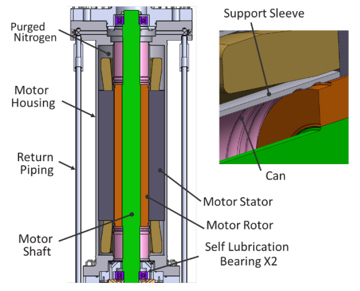
FIG. 3. Canned motor construction.3
The stator windings, which typically contain copper, are sealed within a thin-walled, non-magnetic, high electrical resistance stainless-steel "can." The chamber housing of the stator is purged with N₂ to ensure the absence of O2 and moisture, making the design suitable for liquid NH3 service. In high internal pressure applications, a support sleeve is used to maintain pressure retention and allow for a thinner can; this, in turn, improves motor efficiency by reducing eddy currents.
Torque transmission in a canned motor pump is direct, as the motor and pump are installed on a common shaft. The pumped liquid circulates between the stator's inner diameter and the rotor, providing lubrication for the motor bearings and cooling for the motor itself.
The canned motor design shares the same electrical structure as a typical three-phase induction motor, allowing for minimal constraints on increasing output. However, the presence of the can causes electrical losses due to eddy currents and frictional losses from the circulating liquid, leading to a reduction in motor efficiency compared to conventional motors. Commercially available canned motor pumps typically achieve a maximum flow rate of 4,400 gpm (1,000 m³/hr) and a maximum head of 1,970 ft (600 m).
Magnetic coupling pumps (magnetic drive pumps). Magnetic coupling pumps isolate the entire motor assembly—including the shaft, rotor and bearings—from the pumped fluid using a pressure barrier. A cross-section of an in-tank retractable NH3 pump with a magnetic coupling is shown in FIG. 4.
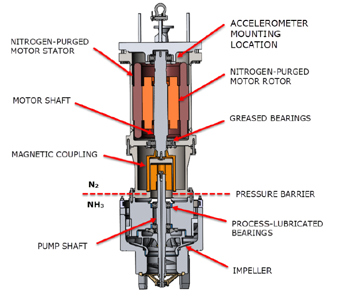
FIG. 4. Cross-section of an in-tank retractable NH3 pump with magnetic coupling. Photo courtesy of Ebara Elliott Energy.
In this design, a pressure barrier (or can) separates the N2-purged motor from the NH3-submerged pump. The pressure barrier is often constructed from a stack of rabbeted stainless-steel rings separated by polytetrafluoroethylene (PTFE) gaskets to decrease eddy current generation and boost torque transmission efficiency. This isolation allows for the use of greased bearings in the motor section, eliminating the risk of contamination from debris mixed in the pumped fluid. Torque is transmitted non-contacting across the stationary pressure barrier via a magnetic coupling, which consists of a driving (outer) rotor and a driven (inner) rotor. The pump and motor utilize separate shafts. The absence of contacting rotating components gives these couplings a theoretically infinite design life. The motor stator and rotor are cooled by utilizing the discharge flow around the motor casing.
There are some advantages and limitations to this design. Magnetic couplings achieve high efficiency due to low eddy current generation and the elimination of frictional losses, and the smaller air gap possible in this design can result in potentially higher motor efficiency than a canned motor design. However, magnetic couplings are subject to limitations in transmissible torque and pressure. The power that can be transmitted is proportional to the coupling radius and inversely proportional to the square of the coupling gap. The maximum pressure and the resulting hoop stress in the pressure barrier limit the size of the coupling. Sizing a magnetic coupling requires careful consideration of the motor's breakdown torque, which can be overcome by using a variable frequency drive to avoid oversizing the coupling. Commercially available magnetic drive NH3 pumps typically achieve a maximum flowrate of 4,400 gpm (1,000 m³/hr) and a maximum head of 328 ft (100 m), though larger capacity pumps are under development.
Condition monitoring for enhanced safety. Given the hazardous nature of NH3, advanced condition monitoring is essential for operational safety and reliability. Both in-tank retractable and vessel-mounted sealless pumps utilize a N2 purge system for the motor housing. The motor housing and flexible conduit assemblies are entirely welded to prevent the loss of N2 purge. The N2 purge pressure is set nominally 14.5 psi (1 bar) above the minimum purge pressure. This design methodology ensures that if a leak were to develop, N2 would leak into the NH3 fluid rather than allowing NH3 to vent to the atmosphere or leak into the motor housing.
In addition to purge monitoring, vibration monitoring is critical for preventing catastrophic failure due to bearing wear. Because vibration monitoring equipment is sensitive to NH3, accelerometers are typically installed inside the N2-purged motor housing, often near the upper motor bearing for the best resolution. Adherence to standards such as API 610, which specifies vibration limits for vertically suspended pumps, guides the design and operation of these systems.
Takeaway and outlook. The energy transition toward decarbonization is driving a substantial increase in the demand for large-scale liquid NH3 pumping, far exceeding the capacity of prior art. Sealless centrifugal pumps, specifically canned motor pumps and magnetic coupling pumps, provide the necessary safety and reliability for handling toxic and corrosive liquid NH3. The primary design challenge for both types revolves around isolating copper-containing motor components from the NH3 fluid and mitigating the efficiency loss caused by the necessary isolation barrier.
LITERATURE CITED
1 Ewing, R., “Japan’s government embracing ammonia as fuel of the future in zero-carbon emissions drive,” ICIS, October 28, 2020, online: https://www.icis.com/explore/resources/news/2020/10/28/10568460/japan-s-government-embracing-ammonia-as-fuel-of-the-future-in-zero-carbon-emissions-drive/
2 Xu, L., A. Elbaz, E. Cenker, J. Sim, X. Bai and W. Roberts, “Reduction of NOx emissions in ammonia combustion using a double-flame premixed co-combustion concept,” Proceedings of the Combustion Institute, 2024.
3 Karakas, E., “Liquid ammonia pumping technologies and applications,” Turbomachinery & Pump Symposia, Houston, Texas, 2025.
4 U.S. OSHA, “Ammonia,” 2024, online: https://www.osha.gov/chemicaldata/623
5 Agency for Toxic Substances and Disease Registry, “Medical management guidelines for ammonia,” U.S. Center for Disease Control, 2017, online: https://wwwn.cdc.gov/TSP/MMG/MMGDetails.aspx?mmgid=7&toxid=2
6 Strategic Innovation Program, “Technical study of CO2-free ammonia supply chain as fuel for thermal power plants,” 2019.
The Authors

Enver Karakas is a distinguished Fellow Engineer and Senior Manager of the Pump and Hydraulic Expander Development Division at Ebara Elliott Energy. He has > 20 yrs of experience in the design and development of turbomachinery for oil and gas applications. Dr. Karakas specializes in cryogenic pump and hydraulic turbine technologies and is responsible for product development, testing and troubleshooting of cryogenic rotating equipment. He earned an MS degree and PhD in mechanical engineering from the University of Nevada, Reno (U.S.). He has been a research associate with the University of Nevada, Reno and has established and led the Turbomachinery Laboratory at the University of Nevada, Reno, where he studied and investigated cavitation performance of cryogenic centrifugal pumps and multiphase flow in cryogenic turbines.

August Brautigam is a Research and Development Engineer at Ebara Elliott Energy, where he is currently focused on the design of ammonia pumps and expanders. He began his career in rotating machinery as an Organic Rankine Cycle Systems Engineer dealing with two-phase screw expanders for ElectraTherm. He then worked as a Project Engineer and later a Research and Development Engineer at Ebara Elliott Energy. Brautigam spent 7 yrs designing medical equipment for laboratory automation at Hamilton Co. and has returned to Ebara Elliott Energy to pursue his long-standing interest in turbomachinery. His primary areas of focus include thermodynamic analysis of power cycles, two-phase power recovery and renewable energy production.

Hiroyuki Fujisawa is the Manager for Custom Pump Product Development at Ebara Elliott Energy, where he leads a cross-functional team of engineers developing new products for the custom pump product lines. He has been with Ebara Elliott Energy since 2022 and has spent most of his time on the engineering and product development of API 610 pumps. His coverage of market segments is not limited to only oil and gas, but includes petrochemicals, power and renewable energy, among others.

Hiroto Hashimoto joined Ebara Elliott Energy in 2012 and currently serves as the Manager of the Custom Pump’s Research and Development department. He has been engaged in the development of ammonia canned motor pumps with a focus on innovative and efficient solutions. Since joining the company, he has contributed to the design and development of various custom pumps, including horizontally split single-stage centrifugal pumps, nuclear pumps and molten salt pumps. Hashimoto also has experience in the design of high-pressure pumps and possesses extensive knowledge of pump products.



Comments