


Digital Feature: Margin left on the table: The hidden cost of supply chain capability gaps in hydrocarbon processing—Part 2
S. DUBEY, AVEVA, Singapore
Part 1 of this article can be viewed here.
The supply chain capability framework: Six layers of supply chain excellence. The failure modes described in Part 1—phantom margin, missed windows, defensive buffers, and repeated leakage—reflect specific capability gaps that can be structurally defined. Every practitioner who has lived through a plan vs. actual disappointment or watched a market window close while the organization was still assembling the picture already knows, intuitively, what was missing. The supply chain capability framework that follows formalizes that intuition.
Start with phantom margin. The plan missed actuals because functions planned based on different assumptions, uncertainty was not sized and the planning model was not challenged cross-functionally. Three capabilities are missing:
- The ability to build a shared, confidence-characterized picture of reality (situational awareness and context framing).
- The ability to produce a cross-functionally committed plan that is stress-tested for uncertainty and stretched by questioning all constraints (resilient planning under uncertainty).
- The ability to diagnose why the plan missed and correct the models, assumptions and workflow for next time (continuous learning and system improvement).
Now, consider missed opportunities. The organization saw the crack spread spike but could not assemble a cross-functional response before the window closed. What was missing?
- Designed optionality in the plan—uncommitted volumes that preserve degrees of freedom—and pre-qualified alternatives that make those options actionable (resilient planning).
- A real-time, cross-functional execution picture, and a capability to optimize at execution based on available degrees of freedom (nowcasting and execution optimization).
- A detection mechanism that anticipates the signal and routes it to the right response before the cadence-based planning cycle catches up (forward sensing and dynamic replanning).
Defensive operations—the quiet accumulation of buffers and protective margins—persist because:
- Functions cannot see each other’s picture (situational awareness)
- Buffers are set by convention or single-factor rules rather than sized against the full economic tradeoff they represent (context framing and resilient planning)
- No one has quantified the cumulative cost of these buffers or initiated action to address them (continuous learning).
Repeated leakage compounds all three: without a structured learning capability that decomposes outcomes into attributable causes, the same losses recur period after period (continuous learning).
One capability appears absent from this mapping: governance. Not because it is unimportant, but because it does not capture margin directly. It enables every other capability to function—through decision rights, cadence and governed data flows—and its absence amplifies every margin leak described above.
These six layers—governance as the foundation, situational awareness and resilient planning shaping the plan, execution optimization and forward sensing acting on the residual gap, and continuous learning closing the feedback loop—form the supply chain capability framework (FIG. 1). Each layer depends on the ones below it, and the combined effect is the difference between an organization that leaves margin on the table and one that systematically captures it.
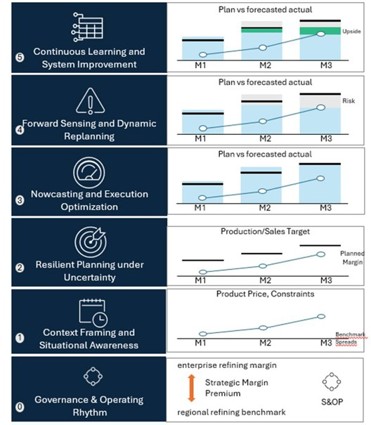
FIG. 1. The six capability layers: Layer 0 establishes governance and operating rhythm. Layer 1 builds the contextual picture: market, internal, confidence levels, risks and exposure. Layer 2 translates context into production and sales, with planned margin and risk management targets. Layer 3 nowcasts the current operational position and optimizes execution as conditions diverge from the plan. Layer 4 monitors continuously for signals, routing emerging risks and opportunities to the appropriate response. Layer 5 closes the learning and improvement loop.
The layers are not sequential phases or maturity stages, they are capability domains, each with its own purpose and dependent on the layers below it. An organization can—and typically does—have uneven maturity across layers. Each layer contains a number of capabilities (FIG. 2), where a capability is the ability to perform a particular task or activity.3 The framework is an organizational blueprint, a structured answer to the question: What must each function be able to do, and how must they work together, to convert available margin into realized margin? Each layer is defined by the decision outcomes it must produce—a validated planning basis, a stress-tested plan, an optimized execution program—and margin leakage traces to where those outcomes are missing.
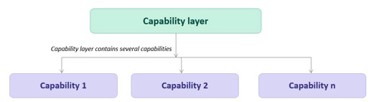
FIG. 2. Capability layer decomposition: Each capability layer contains several capabilities.
Layer 0: Governance and cross-functional foundation. Every capability in the framework rests on governance infrastructure: defined roles and accountabilities, governed data flows, policies that set risk boundaries, a cadence of decision forums that synchronize functions, decision rights, performance measurement that reinforces the right behaviors and change management that builds new capabilities when they are needed.
Layer 0 does not propose that the supply chain needs its own governance, separate from the rest of the organization. It asks: Does the organization’s existing governance infrastructure—its delegation of authority, data governance and operating rhythms—adequately serve the needs of end-to-end value chain optimization? In practice, the answer is often “partially.” The organization may have robust financial delegation but no equivalent for operational decisions, such as crude selection or changes in production mode. It may have excellent safety governance, but no structured approach to supply chain risk appetite. It may have well-governed trading mandates, but no mechanism linking hedge positions to the planning basis they are meant to protect. Without governance that extends to these domains, every other capability is person-dependent, and person-dependent capability does not scale, does not survive turnover and does not improve systematically.
Layer 1: Situational awareness and context framing. The quality of any supply chain decision is bounded by the quality of the context in which it was made. No planning model, no matter how sophisticated, can compensate for inputs that are stale or incomplete. The most dangerous are those that are silently wrong. Nothing flags these errors; the input enters the plan looking like a valid assumption, creating value that appears in the model but cannot be realized in execution: a wrong yield in the assay table, a model default no one remembers setting or an availability status that was never updated after a deration.
Layer 1 establishes the shared picture of reality that underlies all planning decisions. It assembles external signals—market economics, supply-demand balances, competitor behavior, regulatory developments, shipping conditions—and internal realities—asset status, inventory positions, committed obligations and utility availability. Critically, Layer 1 assigns explicit confidence to every key input—evaluating source reliability, timeliness and uncertainty bandwidth—so that planning does not treat all inputs as equally reliable, and the confidence profile directly shapes what sensitivities are tested and how aggressively the plan commits margin.
Layer 1 then contextualizes risk and exposure, deriving financial, operational and logistics vulnerabilities from the intersection of external conditions, internal positions and confidence levels. It also tracks the commitment picture: the hedge book as the record of which economics are already locked and which positions remain open to the market, uncommitted crude volumes as both procurement risk and optionality, and counterparty credit utilization as a constraint on future trading pathways. These commitment and exposure boundaries define what the plan can optimize and what execution can deliver. Layer 1 integrates all inputs into a single, version-controlled, cross-functionally agreed planning basis, eliminating scattered views and ensuring that assumptions, confidence levels and commitments are consistently reflected in the plan.
Layer 2: Resilient planning under uncertainty. Every supply chain plan is a bet — a structured commitment to act under conditions that will inevitably differ from those assumed at the time of planning. The quality of that bet depends not on whether it predicts the future correctly, but on whether it performs well across the range of futures that could materialize.
Layer 2 is where the contextual foundation built by Layer 1 is transformed into forward plans. It brings together analytical optimization, commercial negotiation and trading position management to identify the highest-value operating strategy given the current view of feedstock economics, asset capabilities, market conditions and commitments. It goes beyond optimization to extract and translate marginal-value insights—shadow prices on binding constraints become the economic case for investing time and money to alleviate them. Reduced costs or indifference values on competing feedstocks or product placements become walk-away prices for procurement and sales negotiations, and flexibility analytics built into the optimizer, together with sensitivity analysis, reveal where the plan is fragile and where it is robust. These are not academic outputs; they are the cross-functional alignment tools of resilient planning.
Layer 2 then tests plans against uncertainty, constructing focused scenarios around margin-critical uncertainties, stress-testing the base case and quantifying robustness. The result is not merely a robust plan that survives adverse futures, but a resilient one designed to capture upside through preserved optionality in uncommitted volumes, feed flexibility and pre-qualified placement alternatives.
Finally, Layer 2 gives execution teams the context to execute and adapt intelligently through a structured handoff—the planning and commercial premise—connecting optimization results, scenario ranges and sensitivity maps into a coherent picture that all functions can read.
Layer 3: Nowcasting and execution optimization. A plan is made under assumed conditions. Execution happens under actual ones. Between the planning cycle and the end of the execution period, units derate, cargoes arrive late and crude assays deviate from database values. The question is not whether conditions will differ from the plan, they always do. The question is whether the organization can continuously convert what it observes into coordinated execution decisions that preserve or increase value.
Systematic execution optimization requires that the current operational position—across production, blending, logistics, inventory and commercial commitments—is visible as a single connected picture, updated as signals arrive, not reconstructed from scratch each morning. This is what the “nowcasting” in the layer’s name refers to: before the organization can optimize execution, it must know where it actually stands, not where the plan said it would be. Layer 3 establishes this current position by integrating physical signals (equipment status, tank levels, vessel positions, cargo readiness, commercial delivery commitments) and economic signals (current prices, marginal values, binding constraints, open trading positions) into that connected picture. It then translates the confirmed position into a near-horizon execution program. Within the degrees of freedom available, it extracts incremental value through process optimization. In doing so, optimization also refreshes the economic picture — updating marginal values and identifying which constraints are currently binding — and feeds this back into the nowcast, keeping the economic view as current as the physical one.
Layer 4: Forward sensing and dynamic replanning. Layers 1–3 run on periodic cadence—monthly, weekly, daily—and are always working from a picture that is aging from the moment it was assembled. Layer 4 detects and anticipates conditions that would otherwise result in missed opportunities or unplanned value erosion. The monitoring in this layer is distributed—owned by the functions closest to each signal domain—because the earliest, faintest indications of change are legible only at their point of origin, before they materialize into something a central view would catch: trading desks watching markets and hedge positions, commercial and logistics teams tracking counterparties and vessel movements, and operations teams tracking asset performance and reliability signals. Layer 4 provides the mechanism through which these signals are assessed for supply-chain-wide impact. Where immediate action is needed, Layer 4 responds with bridge actions that hold the supply chain’s position, expediting a cargo, adjusting a hedge or rescheduling a commitment. Where the impact is larger, it routes to the appropriate response: execution adjustment through Layer 3, or out-of-cycle replanning through Layers 1 and 2. Together, these graduated responses, from bridge actions through execution adjustment to full replanning, are what the layer’s name means by dynamic replanning.
The purpose of Layer 4 is anticipation, detecting emerging risks and opportunities early enough to act within the decision window rather than after it has closed. The data infrastructure for much of this already exists and continues to improve, but the organizational capability to surface what matters and route it into decisions often lags behind the data available. Connecting these distributed signals into a single forward projection that can assess supply-chain-wide impact, not just functional impact, is what makes forward sensing systematic rather than episodic.
Layer 5: Continuous learning and system improvement. The preceding layers produce a continuous stream of decisions and outcomes—plans, forecasts and commitments made under specific assumptions, and the actual outcomes that follow. Without a mechanism to compare what was assumed, what was planned and what actually occurred, one-time errors become recurring margin leakage.
Layer 5 closes these loops by linking plans, decisions, execution and outcomes into a continuous learning cycle. It tracks forecast accuracy, model accuracy and plan-vs.-actual variances, not as standalone metrics but as diagnostic inputs that reveal where assumptions broke, where models drifted and where decisions deviated from intent. It decomposes these gaps through model-based backcasting—measuring decision quality, not just performance—and converts them into dollar-denominated priorities through a margin waterfall of which the decomposition in FIG. 3 is an illustrative subset. It also analyzes business processes—cycle times, override patterns, handoff failures—to identify where decisions break down in practice. These insights feed a prioritized improvement portfolio, each initiative sized by its potential to impact margin.
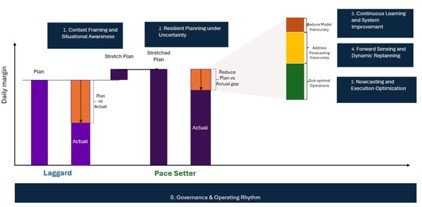
FIG. 3. Source of competitive advantage: The laggard operates with an unexamined plan-vs.-actual gap. The pace setter stretches the plan through better context and model improvements (Layers 1 and 5), reduces the execution gap through resilient planning, nowcasting and execution optimization, and forward sensing (Layers 2, 3 and 4), and decomposes the residual gap into attributable sources that feed continuous improvement (Layer 5), all underpinned by governance and operating rhythm (Layer 0).
These six layers, from governance through learning, separate the organizations that systematically capture margin from those that leave it on the table. The distance between the two (FIG. 3) is not aspiration or technology, but the ability to convert available margin into realized margin, consistently across planning cycles and market conditions. It is these set of capabilities, as defined by the framework, that become the source of durable competitive advantage.
Diagnosing the capability gap. Identifying the six capability layers is necessary but not sufficient, neither for realizing the aspirations nor for ensuring that digital transformation investments deliver their intended value. The organization also needs to know where it actually stands, which capabilities are functioning, which are partially built and which are absent.
Consider a planning model with full data integration across systems but whose outputs are routinely ignored in decision forums—a technical investment with no operational return. Or a market intelligence capability that works impressively — but only inside the trading function. Traders act daily on price movements, emerging supply disruptions and placement opportunities; none of this reaches planning, scheduling or operations, whose decisions are built on a market view weeks older and narrower than the one the desk is acting on. The capability is real, actively used and delivering value — for one function. Measured at the value chain level, it is a gap. In both cases, the real problem is invisible without the right diagnostic lens.
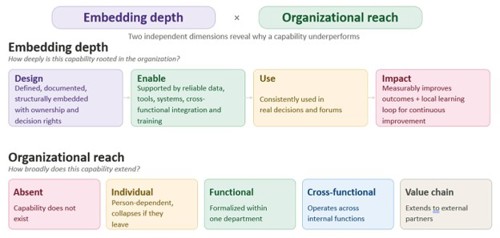
FIG. 4. Maturity assessment methodology: Two independent dimensions reveal why a capability underperforms. Embedding depth traces the causal chain from Design → Enable → Use → Impact. Organizational reach measures how broadly the capability extends, from Absent → Individual → Functional → Cross-Functional → Value Chain. Each dimension is assessed independently; the pattern of scores identifies the specific intervention needed.
The supply chain capability framework assesses capability maturity across two independent dimensions (FIG. 4):
- Embedding depth: This measures how deeply a capability is woven into the organization’s fabric, from design (has it been defined?) through enable (is it supported by systems and accessible?) through use (is it actively practiced in real decisions?) to impact (does it demonstrably improve outcomes?).
- Organizational reach: This measures how broadly the capability extends, from person-dependent through functional to cross-functional and beyond to value chain partners.
A capability can score high on one dimension and low on the other, and the pattern reveals the intervention needed. Strong enablement with weak use signals a governance or adoption gap, not a technology gap. Strong cross-functional reach with weak design signals informal coordination that has not been formalized and is therefore fragile. The two dimensions together surface the specific failure mode that a blended score would conceal. Each capability is further decomposed to enable a diagnosis that can identify precisely where a capability breaks down and what intervention is needed.
Moving forward. For an organization ready to act, the path forward begins with a structured diagnosis: what is the business strategy for the supply chain, and where specifically are the capability gaps that prevent it from delivering on that strategy? The six capability layers now give those questions concrete substance, and different root causes require different interventions. A sensing gap calls for different actions than a planning gap, a governance gap or an execution gap. The framework provides the diagnostic vocabulary to distinguish between them.
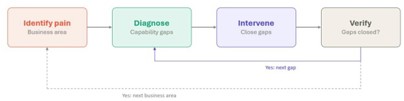
FIG. 5. Iterative deployment: Start where the business pain is most visible. Diagnose which capabilities are underperforming and why, using embedding depth and organizational reach at the task level. Intervene to close the identified gaps. Verify whether the gap has closed. If yes, address the next gap (inner loop); move to the next business area once the current one is addressed (outer loop).
Two approaches are possible. The first is a comprehensive maturity assessment, evaluating all six layers across both dimensions to produce a complete picture of organizational supply chain capability. This suits an organization launching a transformation program with executive sponsorship and budget. For most organizations, a more practical path (FIG. 5) starts where the business pain is most visible. The framework provides the diagnostic vocabulary; the business pain provides the starting point.
In either case, the diagnosis operates at the task level, not “we need better planning” but “our scenario analysis does not test the three uncertainties that drove 80% of last quarter’s margin variance.” This specificity is what connects diagnosis to action: each task-level gap maps to a concrete intervention—a process change, a governance mechanism or a technology enablement.
The cycle then repeats. Has the intervention closed the gap? If yes, move to the next gap contributing to the same business pain. Once that pain is addressed, the next area where margin leakage is visible. Over successive iterations, the organization builds capability systematically, not through a single transformation program, but through a continuous cycle of diagnosis, intervention and verification.
Ultimately, this is not an IT project, nor is it a planning department initiative. Some capability gaps live within functions—a planning process that optimizes but does not extract marginal value insights. Others live at the seams, trading and planning operating from different price decks. Building supply chain capability requires addressing both, sponsored at the level where these functions converge.
The margin is on the table. The tools to capture it exist. What remains is the organizational capability to put them to work, systematically and at scale.
LITERATURE CITED
3 Helfat, C.E., S. Finkelstein, W. Mitchell, M. A. Peteraf, H. Singh, D. J. Teece and S. G. Winter, Dynamic Capabilities: Understanding Strategic Change in Organizations, Blackwell Publishing, 2007.
Related News
- Michelin and Axens enter into discussions to accelerate the deployment of a key bio-based molecule for green chemistry
- Airbus and MTU Aero Engines partner to develop/commercialize fully electric hydrogen fuel cell engine
- Digital Feature: Margin left on the table: The hidden cost of supply chain capability gaps in hydrocarbon processing—Part 2



Comments