

Sherwin-Williams unveils new advanced energy barrier that eliminates threat of corrosion under insulation
- Heat-Flex AEB rivals thermal retention capabilities of traditional insulation systems for a more sustainable approach to insulating assets
With Heat-Flex® AEB (Advanced Energy Barrier), the highly costly and dangerous phenomenon of corrosion under insulation (CUI) could be a thing of the past. Because by replacing the bulky mineral-based insulation traditionally used on storage tanks, process vessels, and piping to retain heat, the innovative coating essentially eliminates the conditions needed for CUI to develop in the first place.
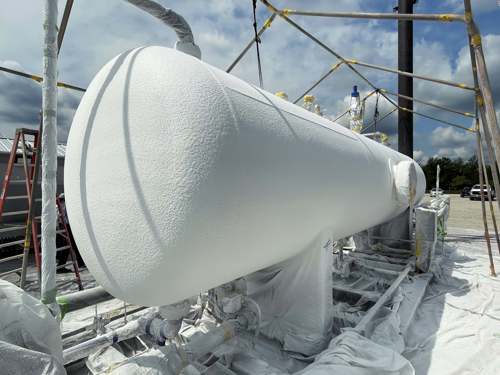
CUI occurs when water penetrates traditional insulation systems and becomes trapped against metal surfaces, creating a corrosive environment that is often hidden from view. Heat-Flex AEB replaces such insulation with a thick film of insulative coating material, capable of retaining operating temperatures of up to 177°C (350°F), with excursions to 204°C (400°F).
Neil Wilds, Global Product Director – CUI, at Sherwin-Williams Protective & Marine, said: “Corrosion under insulation requires the presence of insulation. By removing this from an asset and applying the thermal insulative coating in its place, there is no longer any physical system under which corrosion under insulation could occur. Therefore, the corrosion under insulation is eliminated by default. We’re kissing both insulation and CUI goodbye.”
The thermal insulative coating offers a variety of enhanced sustainability benefits. By eliminating CUI, it helps extend the lifespan of steel assets, minimising the environmental costs of production and maintenance. In addition, it eliminates the manufacturing, shipping and storage of the materials required for a traditional system, from mineral wool insulation and the wiring, pins and banding that keeps insulation in place, to the metal cladding. Importantly, unlike traditional insulation systems that lose efficiency with the inevitable moisture ingress Heat-Flex AEB has a consistent thermal efficiency. This enables the maintenance of required operating temperatures without increasing process heat and, therefore, energy usage.
Neil Wilds continued: “When developing Heat-Flex AEB, we needed to ensure the coating itself could retain process heat at temperatures high enough to remove traditional insulation and not affect the consistency and flow of materials housed inside assets. Careful manipulation of the coating molecule and product formulation enabled this surprising capability, which has notable ramifications for reducing costs and improving carbon footprints, while enabling efficiencies in various facility applications.”
Applying Heat-Flex AEB is significantly easier, faster and safer than installing bulky insulation systems, which requires workers to wrap, band, and cover insulation while in close proximity to hot assets. Heat-Flex AEB is an easy-to-use 1K coating – simply open, mix and apply. A single applied coat will instantaneously reduce the surface temperature, removing any burn risk. Unlike with traditional insulation systems, Heat-Flex AEB is applied via spray. This means personnel are not in close proximity to hot assets during coating, meaning assets can operate at up to 148°C (300°F) during application to minimise disruption. New assets can also be coated quickly and efficiently in pre-assembly yards rather than in-situ.
Heat-Flex AEB is typically sprayed over a primer, which is directly applied to prepared steel to protect it from corrosion. Recommended primers include Heat-Flex 750 and Heat-Flex ACE.



Comments