

Trelleborg launches reduced carbon footprint ethylene propylene diene monomers
Trelleborg Sealing Solutions marks a step change in the environmental impact of critical industrial polymers with the launch of two ethylene propylene diene monomer (EPDM) rubber grades demonstrating up to a 55 percent lower product carbon footprint (PCF).
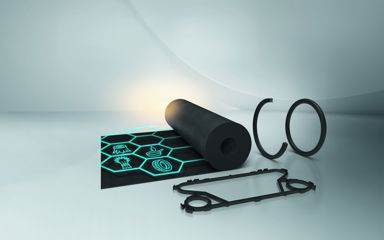
The range of reduced carbon footprint materials features a 70 Shore A and an 80 Shore A material with uncompromised performance compared to traditional EPDMs.
Project Manager Dr. Jekaterina Miller says: “Our new reduced carbon footprint EPDMs are created from raw polymers based on non-fossil sources derived from renewable ingredients such as cooking oil, straw, forestry residue and tall oil.
“The materials offer significant environmental benefits because the feedstock comes from circular sources. Although it achieves up to a 61 percent reduction in carbon footprint in compound form, the final formulations are comparable to traditional EPDM elastomers made from fossil-sourced inputs, ensuring equivalent application performance.
“Based on this circular feedstock, the materials offer ‘no compromise’ alternatives that substantially lower the carbon footprints of our customers’ products. Using recognized methodology, we calculate that molded articles made from the 70 Shore A and 80 Shore A materials can achieve up to a 33 percent and 55 percent reduction in PCF respectively1.”
The range comprises the 70 Shore A hardness E7T11 and 80 Shore A E8T12, both ideal for the production of O-Rings, gaskets and custom-engineered products. The grades are suitable for solutions in the automotive, processing, manufacturing, automation, energy, agriculture, and construction and mining equipment sectors.
They seal applications in engines, doors, pumps, valves, line connector seals, household appliances, air cylinders, solar panels, marine hatches and doors, and an array of functions for heating, ventilation, air conditioning, freezing and refrigeration.
Developing the new materials in partnership with sustainability leader and raw materials supplier Arlanxeo, the two EPDM compounds are created from polymers derived from used cooking oil, straw, forestry residue and tall oil. In compound form, E7T11 has a carbon footprint reduction of 51% and E8T12 a carbon footprint reduction of 61% compared to traditional materials.
Arlanxeo’s bio-circular EPDM grades are ISCC PLUS certified using the “mass balance approach” which tracks the use of bio-circular feedstock in the production of their rubber. This guarantees that the volume of bio-circular products sold under the Keltan® Eco-BC polymers label is consistent with the source feedstock.
Trelleborg then combines the EPDM with a combination of recycled carbon black derived from sources such as used tires, and other sources, to create the compounds.
To ensure the validity of the methodology for PCF calculations, Trelleborg worked with Sphera Solutions, experts in sustainability and operational risk management software platforms. The methodology is in the process of being validated by DEKRA, an internationally recognized certifying authority.


Comments