


Europe's summer flights at risk as Iran war exposes refining decline
European holidaymakers may need to rethink their summer travel plans as airlines brace for possible flight groundings amid a mounting fuel supply crunch triggered by the Iran war. This crisis marks another wake-up call for a region grappling with energy security in an era of heightened geopolitical tensions.
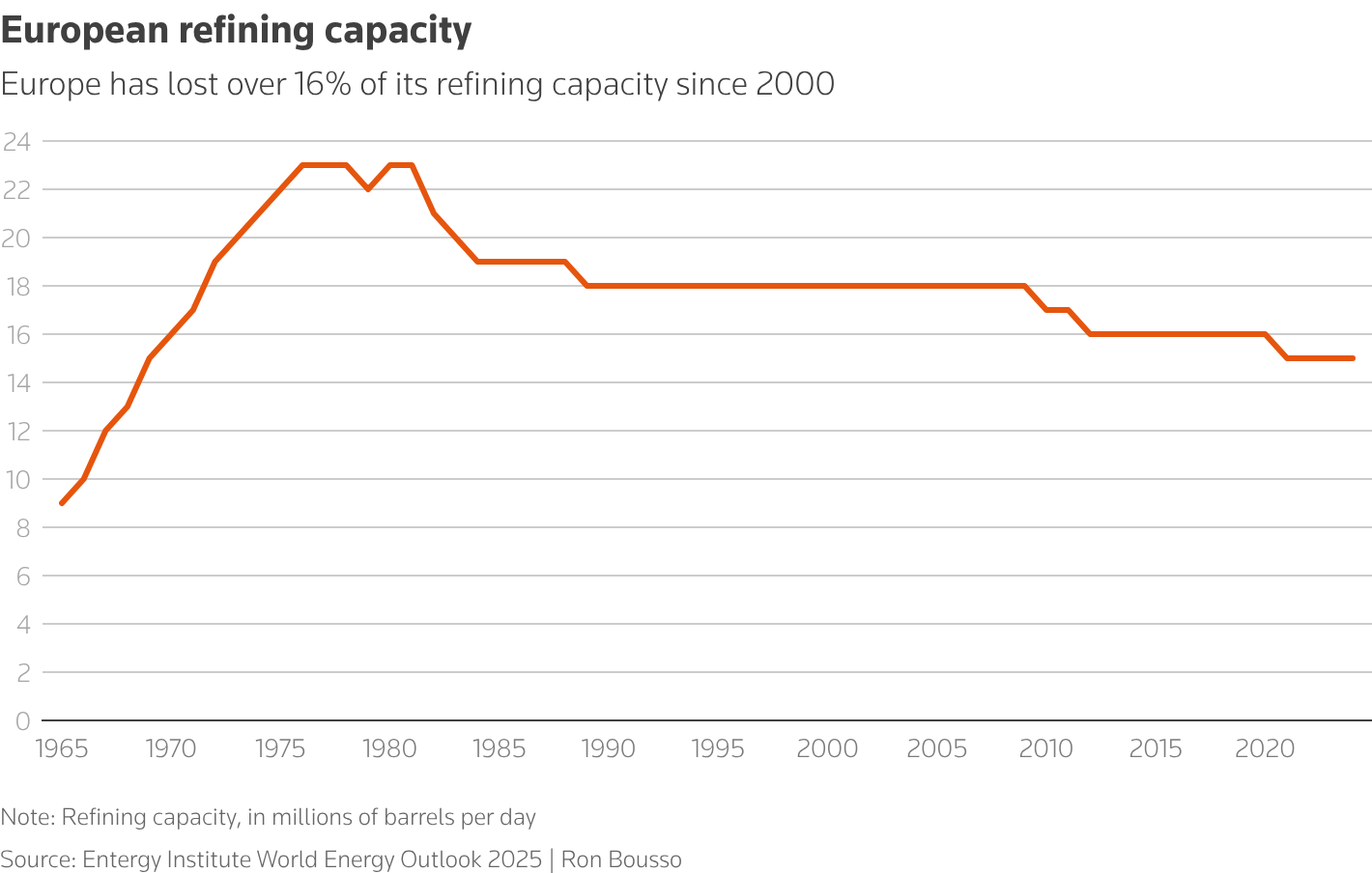
Europe’s oil and gas industry has shrunk dramatically over the past 25 years: North Sea production has dwindled and more than 30 refineries - 16% of refining capacity - have been shuttered across the continent.
(click image to enlarge)
The contraction reflects a combination of shrinking domestic demand, rising overseas competition and, increasingly over the past decade, a government-led drive to curb greenhouse gas emissions.
The upshot is that Europe has become heavily reliant on energy imports - a vulnerable underbelly painfully exposed twice in four years.
First came the abrupt loss of Russian natural gas supplies following Moscow’s invasion of Ukraine in 2022. Then the closure of the critical Strait of Hormuz during the Iran war - now in its seventh week - has once again laid bare the risks of Europe’s growing exposure to international energy shocks.
Nowhere is that vulnerability clearer than in aviation fuel.
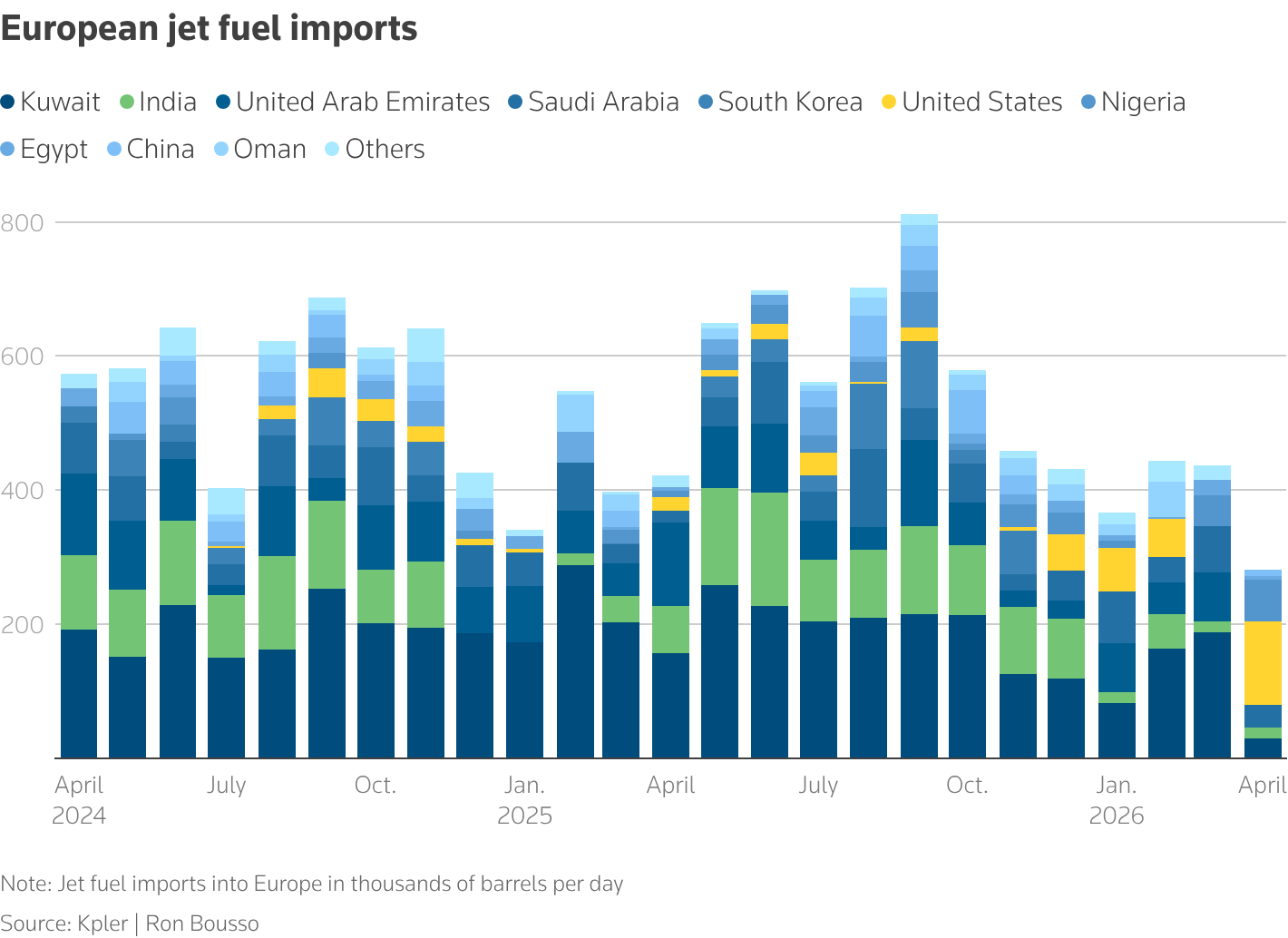
JET FUEL SUPPLY CRUNCH. Europe is more dependent on jet fuel imports than for any other transport fuel. The region consumed about 1.6 MMbpd last year, of which roughly 500,000 bpd were imported, according to the International Energy Agency. Around 75% of those imports came from the Middle East.
(click image to enlarge)
That dependence has left Europe acutely exposed to the Gulf supply shock.
Refineries in Asia, which source about 60% of their crude imports from the Middle East, were forced to scale back operations by some 3 MMbpd between February and April, according to the IEA.
That pullback triggered acute fuel shortages across Asia, prompting governments to respond with fuel-saving measures, subsidies and, in some cases, restrictions on fuel exports - including in China.
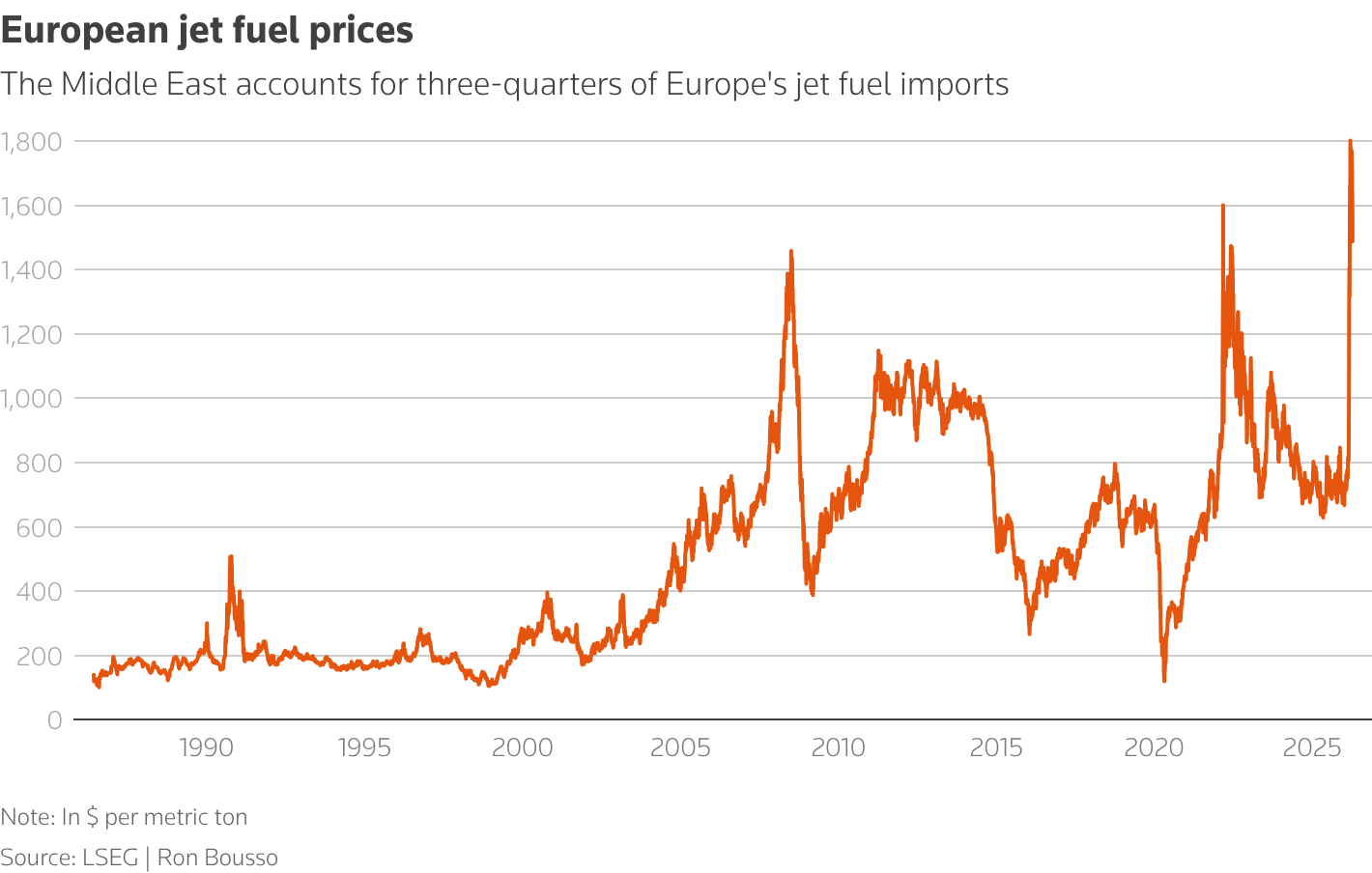
With Asian demand competing for scarce barrels, benchmark European jet fuel prices surged to an all-time high of $1,800 a ton on March 18, before easing to around $1,450 this week. Jet fuel refining margins have also surged to record highs, exceeding $100 per barrel, more than five times their level a year ago, according to HiLo Analytics.
(click image to enlarge)
Europe has struggled to replace the lost Middle Eastern barrels. Jet fuel imports fell to roughly 437,000 bpd in March, down 13% from the 2025 average, and are set to slide further to just 275,000 bpd in April, according to analytics firm Kpler.
Importantly, around 125,000 bpd of April’s imports are expected to arrive from the U.S. - a shift to long-haul sourcing that underscores just how stretched the supply chain has become.
Regional stockpiles are also being depleted rapidly. Independently held jet fuel and kerosene stocks in the Amsterdam-Rotterdam-Antwerp refining and storage hub fell nearly 8% last week to 646,000 metric tons, the lowest level since March 2023, according to Dutch consultancy Insights Global.
The last cargoes of jet fuel from the Middle East are now approaching Europe. That means finding replacement barrels will soon prove even more challenging – and more expensive.
LIMITED OPTIONS TO CUSHION BLOW. Industry group Airports Council International Europe (ACI) warned last week that the region could face a systemic jet fuel shortage within just three weeks.
With supplies critically tight, airlines and oil importers face two unpalatable options: bid up prices to compete with Asia for scarce barrels, or cut consumption.
Lufthansa CEO Carsten Spohr warned on Tuesday that grounding aircraft "may be unavoidable" as shortages hit major airports.
Europe's biggest airline has drawn up contingency plans that include cutting capacity by up to 5%, potentially grounding 20–40 older, less fuel-efficient planes earmarked for early retirement.
Spohr said Lufthansa, which hedges fuel up to 24 months ahead and was 85% hedged as of December 31, was well placed in the short term.
Not all carriers are so insulated. EasyJet has hedged the majority of its fuel needs for the coming months, but those positions begin to unwind by the end of summer, when the British budget carrier has warned ticket prices could rise.
Airlines for Europe (A4E) has requested that the European Union introduce crisis response measures, including: EU-level monitoring of jet fuel supplies, a temporary suspension of the bloc's carbon market for aviation, and scrapping certain aviation taxes. The industry group's requests were outlined in a document seen by media.
The crisis lays bare the strategic cost of allowing domestic energy infrastructure - from refineries to upstream oil and gas production - to wither without reliable alternatives in place.
Governments' options for short-term relief are limited, and the most obvious ones, such as temporarily easing carbon-related taxes on refiners and airlines, clash directly with climate commitments.
Over the longer term, governments could offer refiners incentives to produce low-carbon fuels, expand sustainable aviation fuel production or deploy carbon-capture technologies - policies aimed at reconciling the dual challenge of boosting domestic capacity while cutting emissions.
For now though, the outlook for European airlines - and summer travelers - is bleak.
(The opinions expressed here are those of Ron Bousso, a columnist for Reuters.)



Comments