

Consortium launches study to create a consolidated hub for recycled plastics
- A project selected for the Ministry of the Environment’s Subsidy Program for Feasibility Study to Establish a Stable Supply System for Recycled Plastics for Automobile and Other Applications
A consortium is launching a feasibility study to comprehensively evaluate the collection, sorting, and conversion of post-consumer plastics into recycled feedstock, as well as the material design and traceability of recycled plastics, with the aim of establishing a stable supply system for high-quality recycled plastics suitable for use in automobiles and other applications. The consortium is led by Mitsubishi Chemical Corporation and participated in by Takatoshi Co., Ltd., Toko Metal Co., Ltd., REFINVERSE, Inc., Mitsubishi Electric Corporation, digglue Inc., Japan Polypropylene Corporation and RHOMBIC CORPORATION. Toyota Motor Corp. participates in the consortium as a partner.
The feasibility study has been selected under the Ministry of the Environment’s FY2025 Supplementary Budget Subsidy Program for Feasibility Study to Establish a Stable Supply System for Recycled Plastics for Automobiles and Other Applications.
In recent years, regulations on the use of recycled materials in the automobile sector have been tightened, particularly in Europe, requiring the establishment of a stable supply system for high-quality recycled materials. However, Japan has not yet established such a system, and recycled plastics are rarely used in automobile manufacturing. Against this backdrop, the consortium is implementing a project that aims to develop a business model for efficiently converting sorted plastics into recycled feedstocks and ensuring the stable supply of high-quality recycled plastics by establishing a consolidated hub enabling advanced sorting of post-consumer plastics and ensuring traceability through the use of digital technology and AI. As the initial phase of the project, the participating companies are collaborating on the feasibility study.
Overview of the feasibility study:
The following activities will be implemented through February 2027:
- Developing a concept for utilizing digital technology and AI for advanced sorting of post-consumer plastics
- Study on the usability of recycled materials that meet automotive quality requirements
- Study on the usability of post-consumer plastics that are not suitable for mechanical recycling in chemical recycling
- Identifying data integration requirements to ensure traceability
- Assessment of economic rationality and estimation of the impact of the hub on increasing recycled plastic supply
- Creating an implementational roadmap for phased rollout.
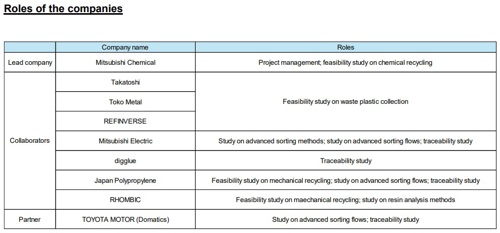
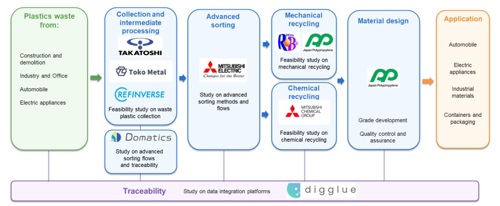
Features of the feasibility study:
- An integrated supply chain based on arterial-venous (A-V) collaboration This project predicates collaboration between “venous” industries responsible for the collection and sorting of post-consumer plastics and “arterial” industries responsible for material design, compounding* , and supply to end-users. This approach enables a comprehensive assessment of the quality, quantity, cost, and chain-of-custody of recycled materials. *Compounding: The process of mixing fillers, colorants, and additives with plastic to create a new type of plastic with enhanced properties.
- Combining advanced sorting and material design By combining advanced sorting technologies for post-consumer plastics with material design technologies for recycled plastics, the project envisions the development of recycled materials that meet the stringent quality standards required for automotive and related applications.
- Optimal utilization of mechanical recycling and chemical recycling. The feasibility study will examine models to maximize the resource value of post-consumer plastics as a whole by grading post-consumer plastics into those suitable for mechanical recycling and those suitable for chemical recycling.
- Improving reliability through traceability The feasibility study aims to utilize a traceability platform to visualize factors such as post-consumer plastics origin, sorting and recycling processes, recycled content, and environmental value, thereby aiming to establish a supply system for recycled plastics that customers can use with confidence.
Future developments
In the feasibility study, the participating companies will identify challenges associated with establishing the hub for recycled plastics for use in automobiles and other applications, and will evaluate post-consumer plastic procurement, quality control, sorting and processing into recycled feedstocks, end-user feedback, traceability, and business viability, as appropriate.
Furthermore, following the completion of the feasibility study, the companies plan to proceed with building a system to supply high-quality recycled feedstocks based on diverse types of post-consumer plastics for a wide range of applications, with a view to transitioning to a pilot project or commercialization.

Comments