


Opinion: China used crude stockpiles to ease Iran shock, but not that much
China did draw on its massive crude oil stockpile in May, but not by nearly as much as may have been implied by the collapse in its imports to the lowest in eight years.
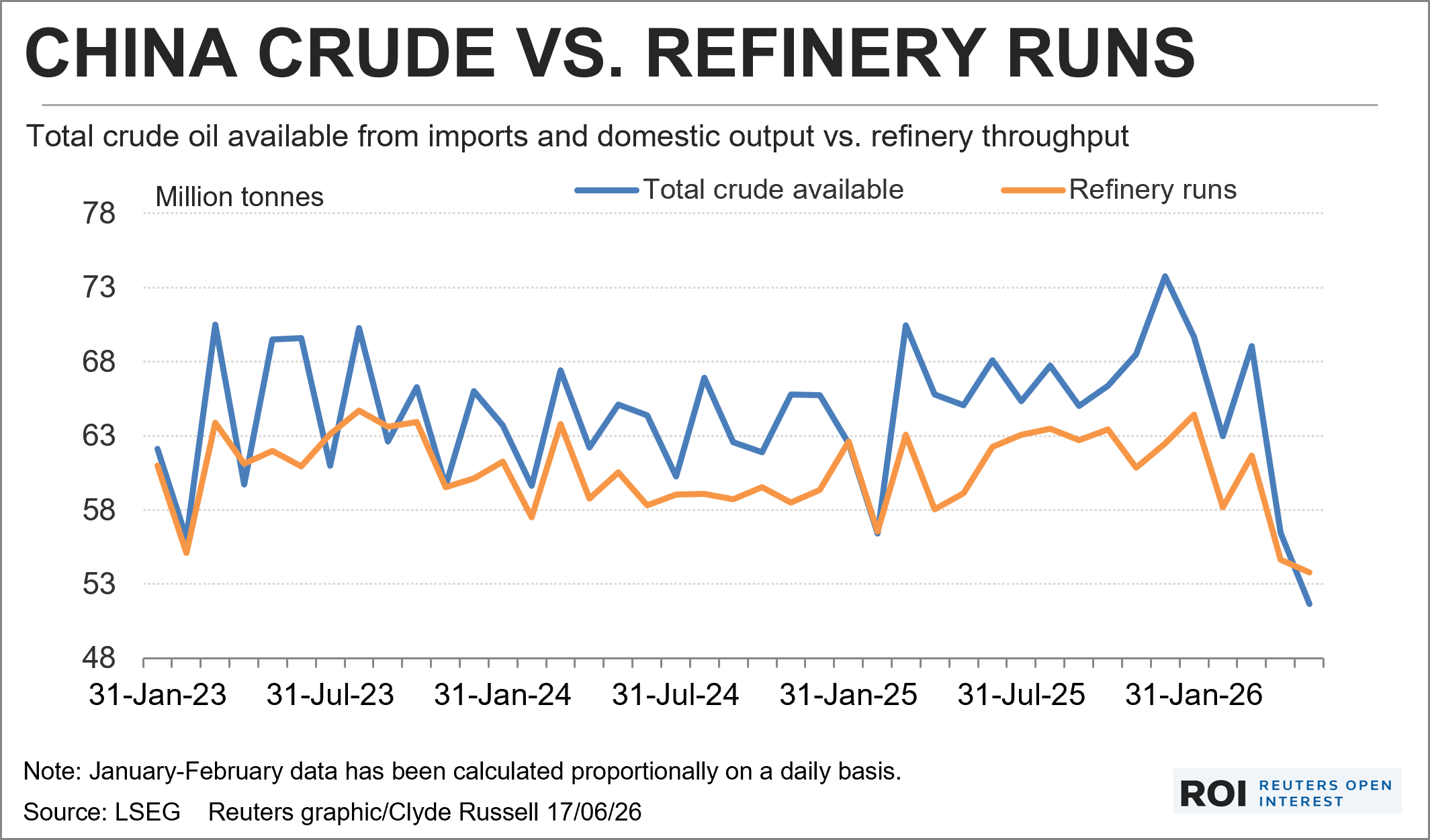
For the first time in 14 months China's refiners processed more crude in May than was available to them from both imports and domestic production.
Refiners processed 12.66 MMbpd in May, the lowest since August 2022, according to data released on Wednesday by the National Bureau of Statistics.
(click to enlarge image)
China does not disclose the volumes of crude flowing into or out of its strategic and commercial stockpiles, but an estimate can be made by deducting the amount of oil processed from the total crude available from imports and domestic output.
Crude imports were 7.79 MMbpd in May, while domestic output was 4.37 MMbpd, giving a total available of 12.16 MMbpd.
This means the available crude was 500,000 bpd lower than what refineries processed, the first time that throughput has exceeded available oil since February 2025.
The draw on inventories seems small, especially when compared to the sharp drop in imports.
In the first three months of the year China's crude imports averaged 11.85 MMbpd, meaning they dropped by just over 4 MMbpd in May.
The gap between the weak imports and the more modest draw on inventories is largely explained by the drop in refinery processing.
For the first quarter China's refiners processed 14.95 MMbpd, meaning that May's figure was 2.29 MMbpd below this.
What the data shows is that China's refiners responded in two ways to the surge in crude prices after the United States and Israel attacked Iran on February 28.
The first was to pare back crude imports dramatically, effectively sending a signal to the market that China would rather use stockpiles than pay elevated prices.
The second was to reduce refinery processing rates, a move that was also related to unofficial curbs on exporting refined products.
By lowering exports of fuels such as diesel, jet kerosene and diesel China's refiners could ensure they could still meet domestic demand without dipping too much into inventories.
China-built options. In effect, China's vast crude stockpile, estimated to contain at least 1.2 Bbbl across both strategic and commercial inventories, gave it options that were not available to many other oil- and refined fuel-importing nations.
It further appears that China did not even have to tap its inventories that much in order to get through the crisis.
It is likely that China's oil companies and political leaders took the view that the Iran war and the resulting effective closure of the Strait of Hormuz would be a temporary problem.
This could prove correct, as the deal struck by the United States and Iran is believed to allow for the full re-opening of the narrow waterway through which as much as 20% of global crude and refined products moved before the conflict began.
If vessels do start to move freely through the strait, it will still take some time for oil flows to normalize, which may see China continue to hold back on boosting imports until prices for physical cargoes start to drop back to pre-war levels.
What China has shown is that it remains a price-sensitive buyer of crude and is prepared to cut imports when prices rise, but equally it increases buying when prices decline.
The Iran war was an extreme event for the crude oil market, with at least 1 Bbbl of supply being lost since it started.
It also led to an extreme reaction by China, which cut both imports and refinery processing to multi-year lows.
While this helped the world adjust to the supply shock, it also underscored that China is the major country best placed to deal with disruptions.
The views expressed here are those of Clyde Russell, a columnist for Reuters.



Comments