

GEA launches enzymatically enhanced GEA eTOP degumming solution
GEA has introduced GEA eTOP Degumming, an enzymatically supported enhancement of its proven TOP degumming process for edible oil refining. The solution delivers higher oil yield, significantly reduced chemical and water consumption, and highly stable low phosphorus levels, driven by a separation concept engineered for robust industrial operation.
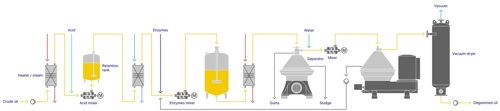
GEA eTOP Degumming builds on GEA’s long‑established TOP degumming process, widely used in physical refining applications and biodiesel pretreatment. An additional enzymatic deep degumming step, enabled by Novonesis' Quara LowP and application expertise, is integrated into a multi‑stage separation architecture developed and engineered by GEA.
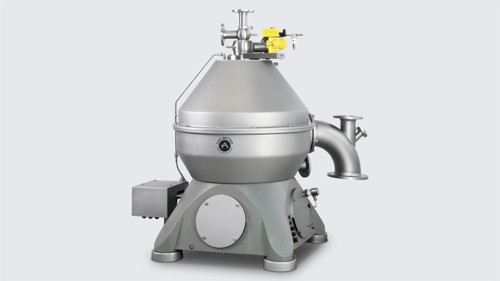
Engineering-driven process stability. The defining element of eTOP Degumming is GEA’s final centrifugal separation stage, which ensures stable and predictable performance under industrial conditions. Based on GEA’s nozzle separator technology, this stage provides the robustness required to fully translate enzymatic efficiency into consistent oil quality in continuous operation.
“Enzymes drive phospholipid conversion and yield improvement, while industrial robustness is achieved through separation and process design,” says Patrick Schürmann, Application Manager Sales - Team Lead Oil & Fat Processing. “With GEA eTOP Degumming, the final separation stage is the key element that makes performance reproducible across varying feedstock qualities.”
The two‑stage centrifugal separation concept, a core feature of GEA’s TOP degumming technology, absorbs upstream fluctuations and safeguards downstream processing, ensuring consistent phosphorus removal and stable interface control.
Practical development driven by customer requirements
The enhanced process was implemented for a customer already operating GEA’s TOP degumming system and seeking further improvements in yield and efficiency. The enzymatic step was integrated and optimized directly within the existing plant, enabling fast commissioning and reliable scale‑up. Novonesis supported the project by providing enzymatic degumming application expertise tailored to the specific feedstock and operating window, while GEA was responsible for overall process design, integration, separation technology, and industrial implementation.
Compared to conventional TOP degumming, GEA eTOP Degumming delivers:
- Up to 1.4% higher oil yield
- Up to 75% lower acid consumption and elimination of caustic
- Water consumption reduced by up to 50%
- Consistently below 10 ppm phosphorus, compared to typical levels above 20 ppm
- Improved gum handling due to reduced viscosity
- More stable operation and smoother commissioning
The consistently low and stable phosphorus content enables reliable downstream processing in physical refining, while improved gum properties simplify separation and handling. This performance results from enzymatic deep degumming enabled by GEA’s engineered separation concept designed for stable industrial operation.
Complementary expertise
GEA eTOP Degumming combines specialized enzyme know‑how with GEA’s long‑standing process and separation expertise. Novonesis, a global biosolutions provider with extensive experience in enzymatic degumming, contributes to efficient upstream phospholipid conversion, while GEA designs the overall process architecture and ensures stable, industrially viable separation and oil quality. This approach allows enzymatic degumming to deliver its full benefit within a process concept defined by GEA’s separation technology and control strategy.
Setting a new benchmark in degumming technology
In edible oil refining, GEA provides complete process lines and key technologies covering crushing, degumming, and chemical and physical refining, supported by extensive process engineering expertise and global service capabilities. With eTOP Degumming, GEA further strengthens its portfolio and sets a new benchmark for process stability, yield optimization, and resource efficiency in degumming.

Comments