


Asia oil floating storage seen declining on lower exports, China buying
- Volume stored in Asian waters has tripled since September to 3-yr high
- Iran, Russia and Venezuela exports fall from highs
- China independent refiners increase buying at wider discounts
- More China crude import quota expected soon
The volume of oil stored on board ships in Asian waters, which has tripled since September to a 3-yr high, is poised to decline as producers of sanctioned oil slow exports and Chinese refiners ramp up buying, trade sources and analysts said.
A surge of exports from countries subject to Western sanctions led by Iran and Russia, as well as tepid Chinese buying, left a glut of oil looking for buyers in the world's biggest consuming region. The excess supply has weighed on prices and cushioned the near-term impact from the disruption of exports from Venezuela.
A large amount of oil was shipped out in recent months in anticipation of tighter sanctions, said Mukesh Sahdev, CEO of energy consultancy XAnalysts.
"The floating storage buildup has passed its peak, and the declines will lend support to oil prices. But it will be unlikely to revert to previously low levels given the increased oil production globally," he said.
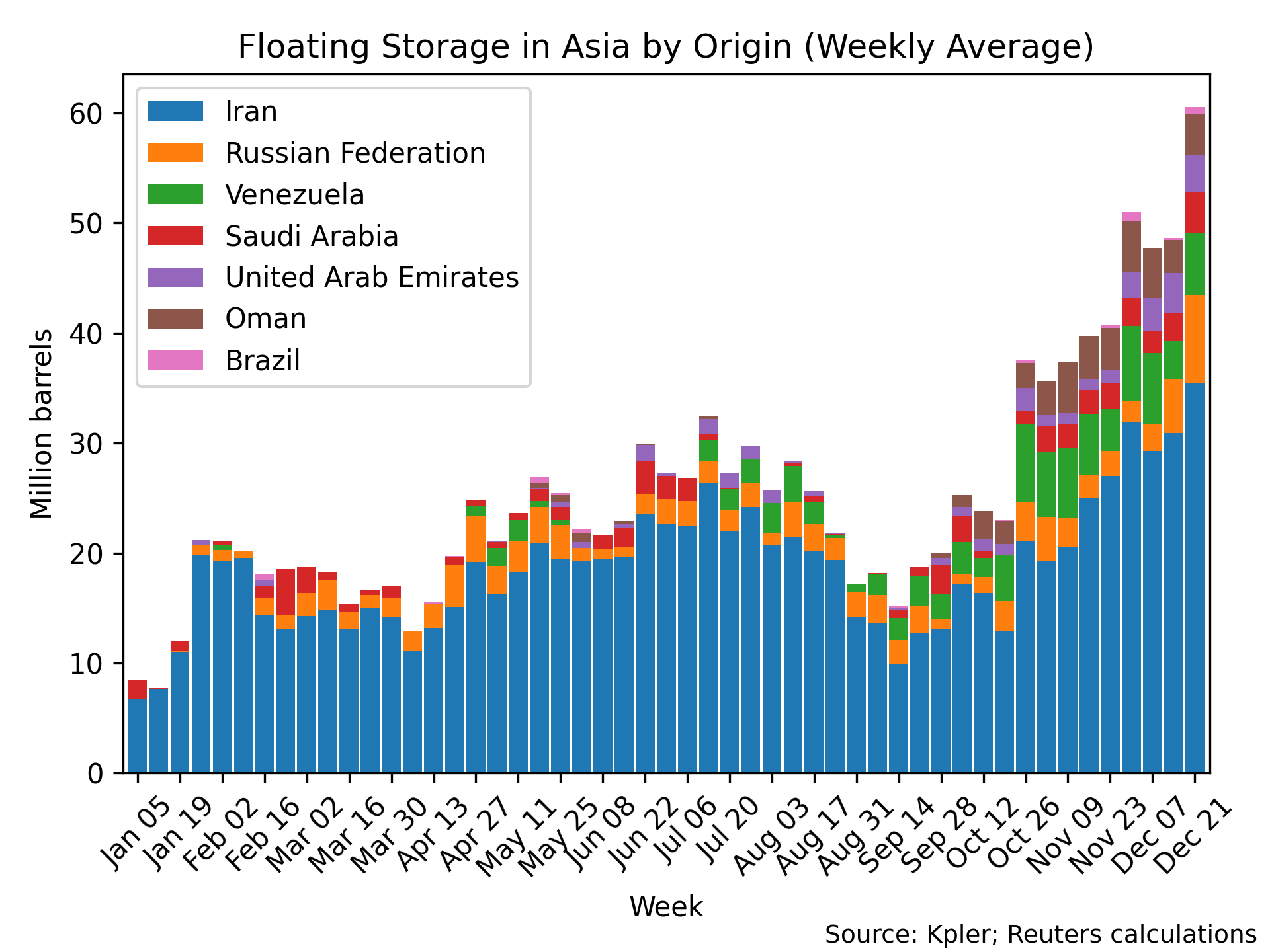
(click image to enlarge)
Asian oil floating storage hit 70.9 MMbbl on December 18, the highest since June 2022 and up from 21 MMbbl at the beginning of September, according to Kpler, a data and analytics provider. Iranian oil accounted for more than half of the stored crude at 38.9 MMbbl, the data showed.
Iran, Russia and Venezuela exports. Iran's exports topped 1.9 MMbpd in September and October, the highest since mid-2018, Kpler data showed, falling to 1.8 MMbpd for November and 1.1 MMbpd so far in December.
Exports from Venezuela have fallen sharply since the U.S. seized a tanker off its coast earlier this month. Venezuelan oil, which accounts for about 4% of China's imports, can take 60 days to arrive, slowing the impact of any prolonged disruption from U.S. operations in the region.
Russian oil exports declined in October and November, weighed down by Ukrainian attacks on ships and facilities, the International Energy Agency said, sliding to 4.71 MMbpd, from 5.01 MMbpd in October and 5.16 MMbpd in September.
Western sanctions on top Russian producers in October prompted Chinese state companies and Indian refiners to pause buying, leading some cargoes to be redirected to China's coastal Shandong province in hopes of finding buyers among independent refiners.
Among them, the U.S.-sanctioned Ladoga loaded 611,640 bbl of Russian ESPO blend at Kozmino in early November and sailed to waters off Singapore on November 13, and was still looking for buyers on December 23, Kpler and LSEG data showed.
However, Russia's exports have risen recently due to unplanned refinery outages caused by drone attacks as well as ample output.
"Into the end of the year, I could see a slight build-up of floating storage if Russian barrels start accumulating, but in the new year, I expect this to start drawing down with greater independent refiner intake with improved margins and new quotas," said Kpler senior oil analyst Naveen Das.
‘Teapot’ buying. Independent Chinese refiners known as "teapots" made purchases from bonded storage for fast delivery after receiving 8 MMbbl of fresh government import quota in late November, enabling more floating storage to discharge, trade sources said.
Meanwhile, more quota for 2026 imports is expected by the end of this year, prompting teapots to order more - especially Russian oil - thanks to cheap prices, they added.
Kpler data showed imports into Shandong accelerating to 3.8 MMbpd so far this month, up from 3.5 MMbpd in November and 3.1 bpd in October.
Discounts for Russian ESPO blend widened to more than $7 a barrel to ICE Brent in Chinese ports, from $5–$6 a barrel early this month and a premium in early October.
Discounts on Iranian light crude held around $8 per barrel for this month, versus about $6 in September.



Comments